Build a S3-Compatible Private Cloud That Performs at Scale
Global enterprises are repatriating workloads from the public cloud to regain control over performance and cost—but they still need cloud-native agility. Discover how companies achieve true S3-compatibility on private cloud infrastructure with MinIO AIStor, eliminating the 20-30 PB wall that limits legacy systems while reaching 1+ exabyte scale.
This comprehensive guide reveals how to build private clouds that deliver hyperscaler performance on industry-standard hardware, with linear scaling, no gateway bottlenecks, and the same developer experience as AWS S3.
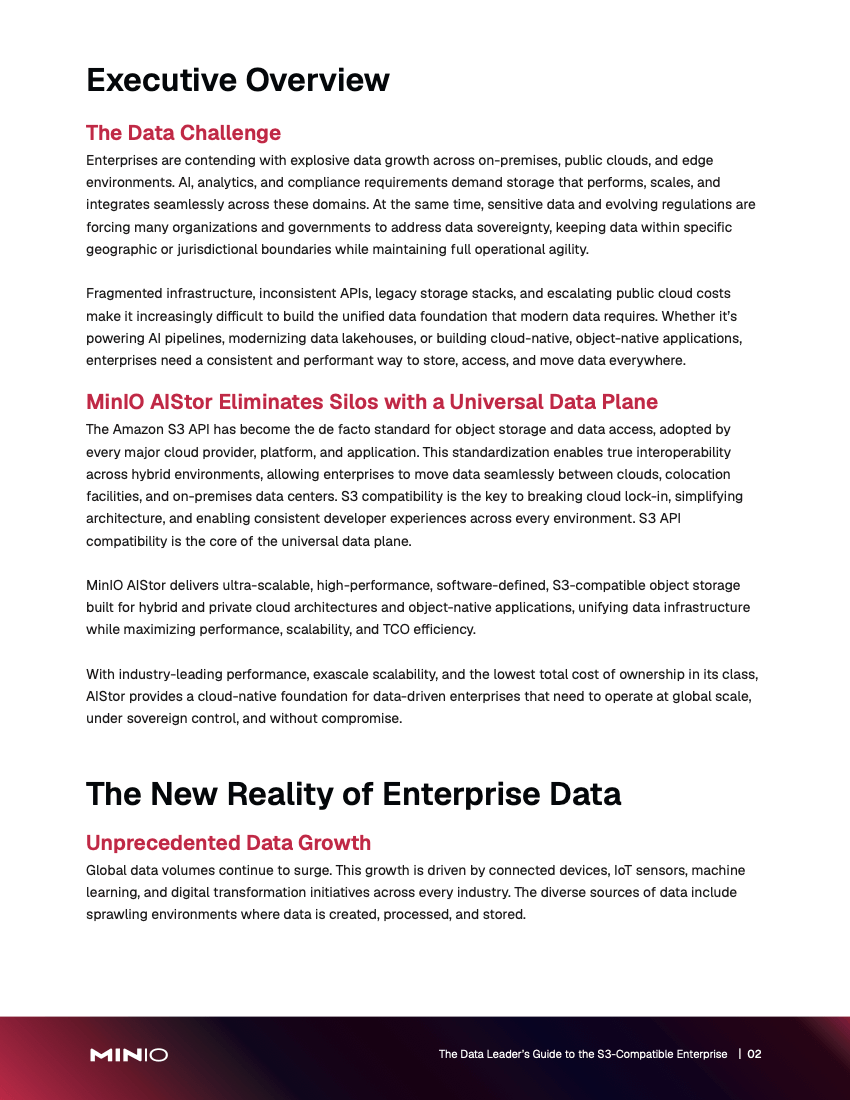
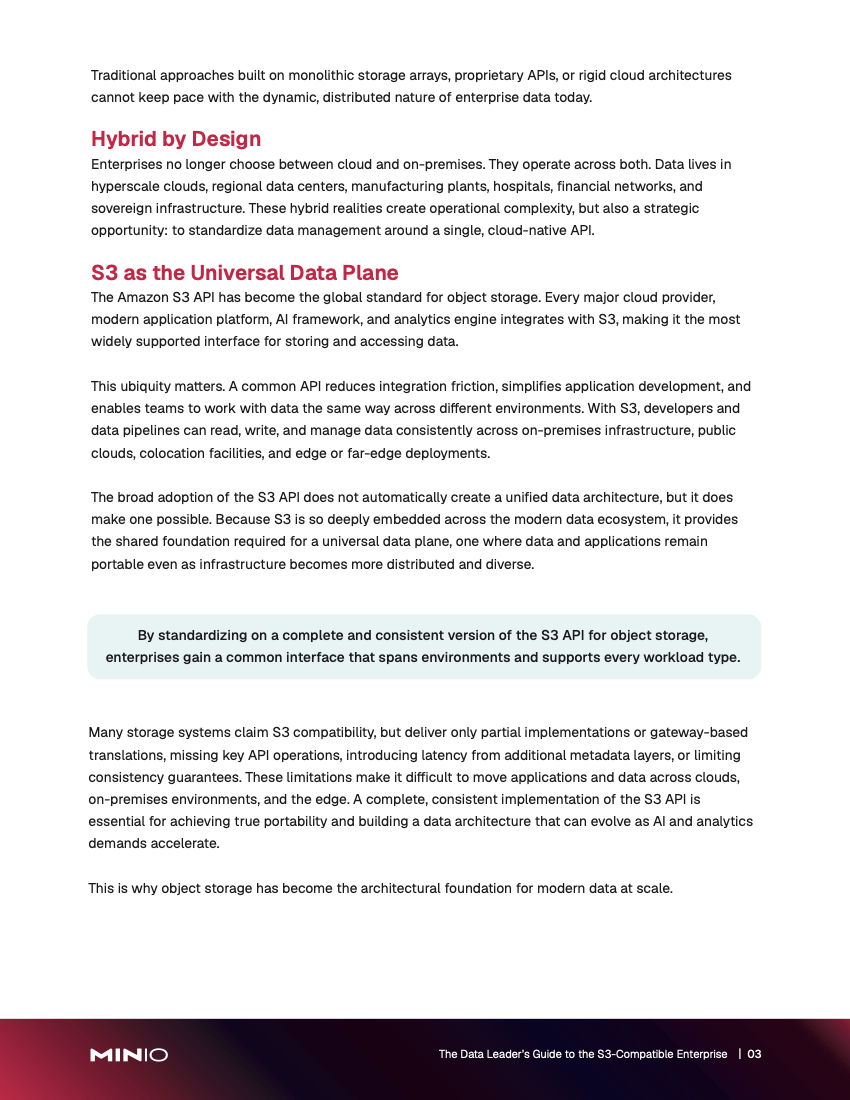
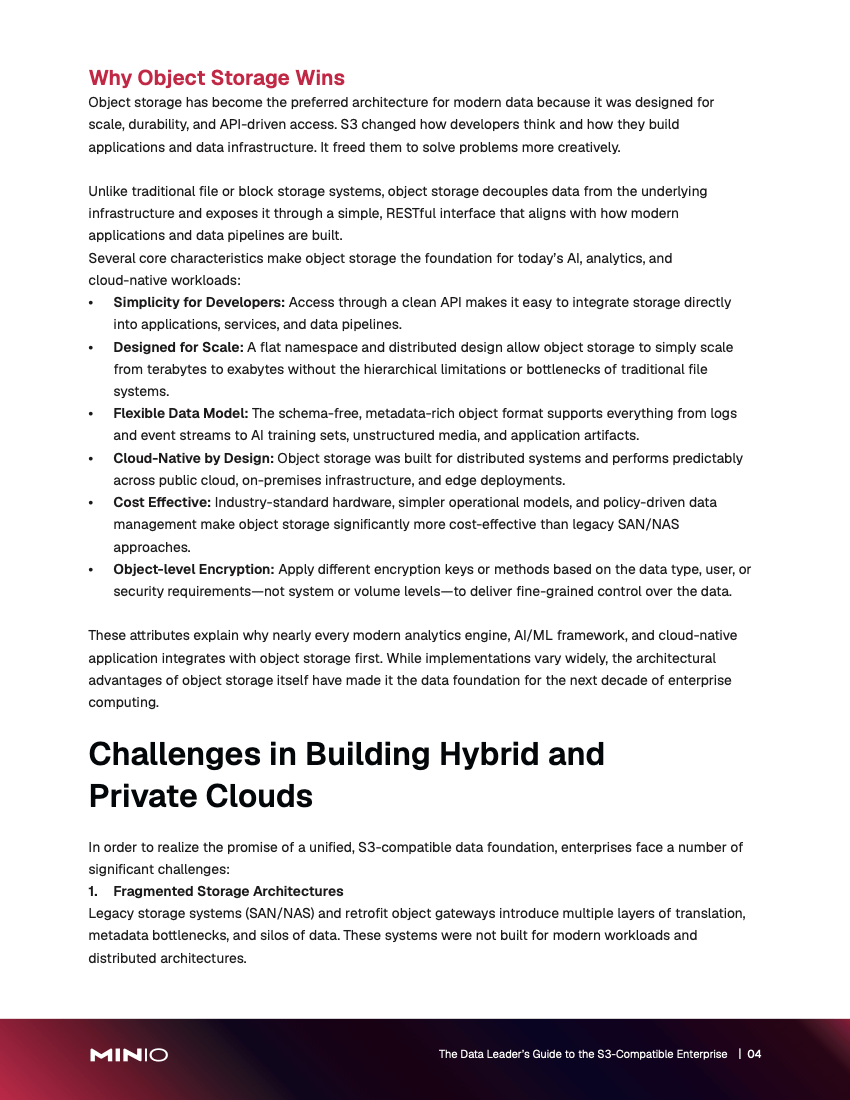
The Data Leader's Guide to the S3-Compatible Enterprise
Learn how to cut cloud costs by 60% while maintaining S3 compatibility and full data control.
What's Inside?
Your Complete S3-Compatible Private Cloud Guide
The Private Cloud Architecture Decision — Compare object-native vs. retrofit gateway approaches, understand why legacy SAN/NAS systems hit the 20-30 PB scaling wall, and learn the technical trade-offs that determine long-term success
Building True S3 Compatibility Without Gateways — Understand the critical difference between native S3 implementation and bolt-on protocols—and why gateway layers introduce latency, metadata bottlenecks, and scaling limitations
Deployment Strategies for Bare Metal and Kubernetes — Step-by-step guidance for deploying S3-compatible private clouds in minutes on bare metal, virtualized infrastructure, or within Kubernetes
Achieving Exabyte-Scale Performance — Explore cloud-native design and stateless architecture, erasure coding, and elimination of metadata bottlenecks to reach 21.8 TB/s aggregate throughput with linear scaling across nodes
TCO Analysis and Hardware Planning — Calculate true cost savings from eliminating egress fees and API charges, leverage commodity hardware for predictable economics, and model your infrastructure requirements for private cloud deployment
Real-World Private Cloud Case Studies — Learn how a global payments provider migrated petabytes from legacy object-gateway systems while maintaining billions of small-file workloads and achieving 70-80% faster report generation
How to Deploy Object-Native vs. Gateway-Based Storage
Evaluate the critical architectural choice between true S3-native implementations and retrofit gateways over legacy SAN/NAS systems, understanding how stateless design eliminates metadata bottlenecks and enables linear scaling from petabytes to exabytes
Performance
Achieving Hyperscaler Throughput on Private Infrastructure
Learn proven techniques for reaching 19.2 TB/s aggregate performance, eliminating the 20-30 PB scaling wall, and feeding GPU clusters without I/O bottlenecks using a single, flat namespace and distributed architecture
Economics
Building Your TCO Model for Private Cloud Migration
Calculate true cost savings from eliminating egress fees and API charges, model hardware requirements for predictable unit economics, and justify private cloud investment with real enterprise benchmarks
Trusted by Leaders
Proven Across Global Enterprises
Ready to Build Your S3-Compatible Private Cloud?
Download the definitive guide to building S3-compatible private clouds that eliminate egress fees while delivering hyperscaler performance. Discover how leading enterprises achieve true cloud portability, complete data sovereignty, and predictable TCO—all on infrastructure you control.
Unified catalog and storage without separate databases to manage or synchronize
Multi-Engine Compatibility
Works seamlessly with Spark, Trino, Flink, and all modern query engines
Hybrid Cloud Deployment
Supports hybrid environments using a 100% S3-compatible API so you can deploy and run anywhere
Real-Time Data Streaming
Native support for Kafka, Flink, and RabbitMQ enables continuous data pipelines from edge to AI
Enterprise Governance
ACID transactions, schema evolution, and fine-grained access control across all workloads for easier security and governance processes
Key Capabilities
Purpose-Built for AI & Analytics
Unified Data Foundation
Combine structured and unstructured data in a single system with native Iceberg integration, eliminating data silos that slow analytics and AI development.
Exabyte-Scale Throughput
Proven at 1+ exabyte with 20+ TiB/s throughput. Handle the largest enterprise data volumes with warehouse-level query performance on lake economics.
Apache Iceberg Native
Built-in support for Apache Iceberg with schema evolution, time travel, and ACID transactions. Plus compatibility with Delta Lake and Hudi.
Optimized for AI/ML Workloads
GPU-optimized data access with native feature store integration. Works with PyTorch, TensorFlow, MLflow, Kubeflow, and all major ML frameworks.
Industry Leader
Trusted by the Fortune 100
77% of Fortune 100 companies rely on MinIO AIStor for their AI/ML and analytics workloads
Ready to Build Your AI Data Lakehouse?
Join the 85% of organizations optimizing their data lakes and warehouses for AI. Download our Data Leader's Guide to learn how leading organizations are evolving to data lakehouses.

















.svg)