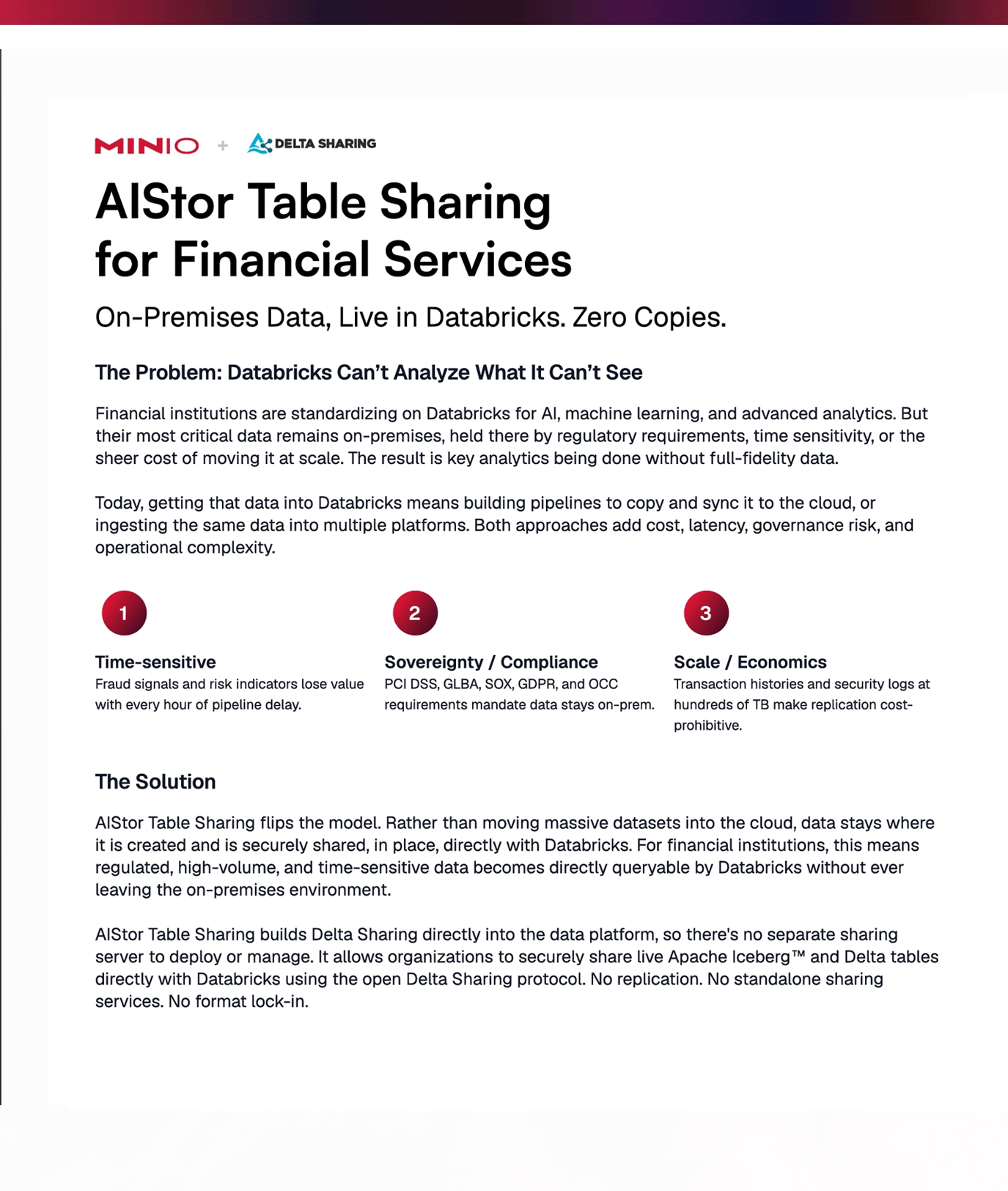
AIStor Table Sharing for Financial Services: On-Premises Data, Live in Databricks. Zero Copies.

About this Resource

Financial institutions have standardized on Databricks for AI and advanced analytics, but their most critical data remains on-premises — held there by PCI DSS, GLBA, SOX, GDPR, and OCC requirements, the time-sensitivity of fraud signals, and the prohibitive cost of replicating hundreds of terabytes to the cloud. Today, accessing that data in Databricks means building pipelines, managing copies, and accepting staleness. AIStor Table Sharing eliminates this tradeoff by embedding the open Delta Sharing protocol directly into the storage platform — no separate sharing server, no replication, no format lock-in. On-premises Iceberg and Delta tables are queried live by Databricks through Unity Catalog without data ever leaving the regulated environment. Benchmarks show queries completing in 1.7–4.1 seconds versus 46–94 seconds for traditional replication and sync approaches. Proven results across financial institutions include: a global financial services provider achieving 84%+ infrastructure reduction and 33% threat detection improvement; NPCI delivering 65% faster fraud model runtime and $Ms in fraud reduction; and Nomura recovering 4+ hours of SLA headroom with 50%+ TCO reduction and production deployment in 2 weeks versus 4 months. Use cases span security and compliance log analytics, regulatory analytics, and enterprise risk and fraud modeling.

Key Takeaways:

AIStor Table Sharing embeds Delta Sharing natively into the storage platform, enabling Databricks to query live on-premises Iceberg and Delta tables without data movement, replication pipelines, or standalone sharing services.

Eliminating data copies reduces the compliance surface area — no additional data to govern, audit, or secure in the cloud — keeping governance boundaries intact under PCI DSS, GLBA, SOX, GDPR, and OCC requirements.

Query performance benchmarks show 1.7–4.1 second completion versus 46–94 seconds for traditional replication and sync, while customers report infrastructure reductions of 84%+ and operational headcount reductions of 87%+.

Who this is for

Data and technology leaders at financial institutions who rely on Databricks for AI and analytics but need to extend that capability to regulated, high-volume on-premises data without compromising data sovereignty or expanding their compliance perimeter.

Related Resources