.svg)
Data Management for Exabyte-Scale Data Store

The Challenge: Data Management That Fragments is Data Management That Fails
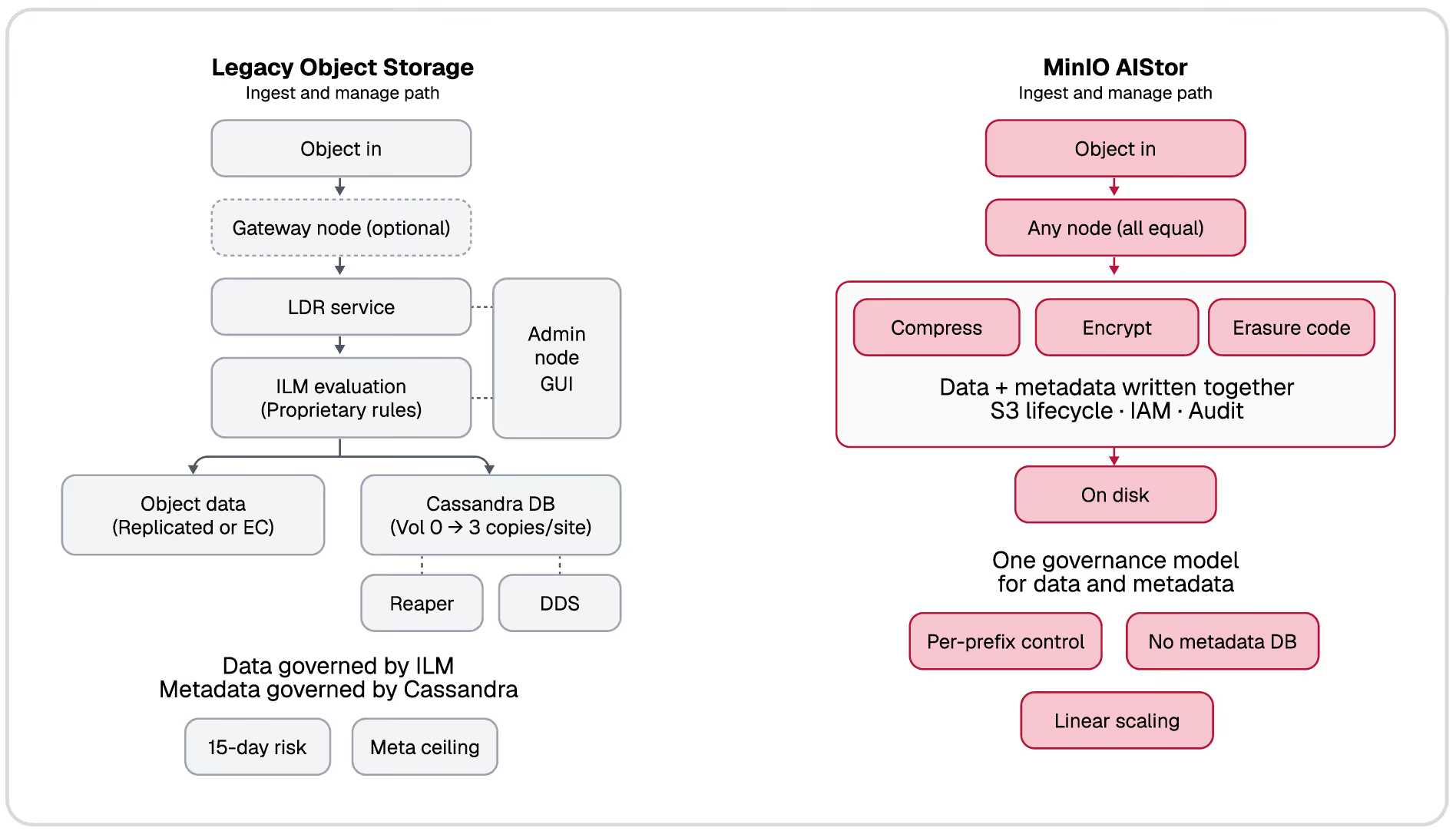
Storage environments at petabyte scale generate operational complexity faster than teams can manage it. Versioning runs in the storage layer. Lifecycle policies run in a separate orchestration engine. Inventory requires an external catalog service. Compression is a post-processing batch job. Each system has its own access control model, its own monitoring surface, and its own failure modes.
The result is predictable. Lifecycle policies drift because nobody reconciles them with the versioning configuration. Inventory jobs miss objects because the catalog service lacks permission to see them. Compression runs hours after ingestion, leaving a capacity planning gap between logical and physical consumption. Audit trails span four systems, so proving compliance means correlating logs that were never designed (to align.
These are not edge cases. They are the operational reality of managing data at scale with disaggregated tooling. The integration tax compounds with every petabyte added.

Integrated Data Management
AIStor eliminates the integration boundaries by building data management into the storage platform itself. When a lifecycle rule transitions a versioned, compressed object to a remote tier, that operation executes within a single system context. The version history, compression metadata, IAM evaluation, encryption state, and audit entry all travel with the object. There is no reconciliation step between subsystems, no metadata synchronization between vendors, and no window where the object's governance state is inconsistent. This is the architectural foundation that makes everything below possible.
Object Versioning
Data protection is the foundation. Everything else, lifecycle, inventory, compression, builds on the assumption that objects are durable, recoverable, and tamper-proof. Versioning is where that starts.
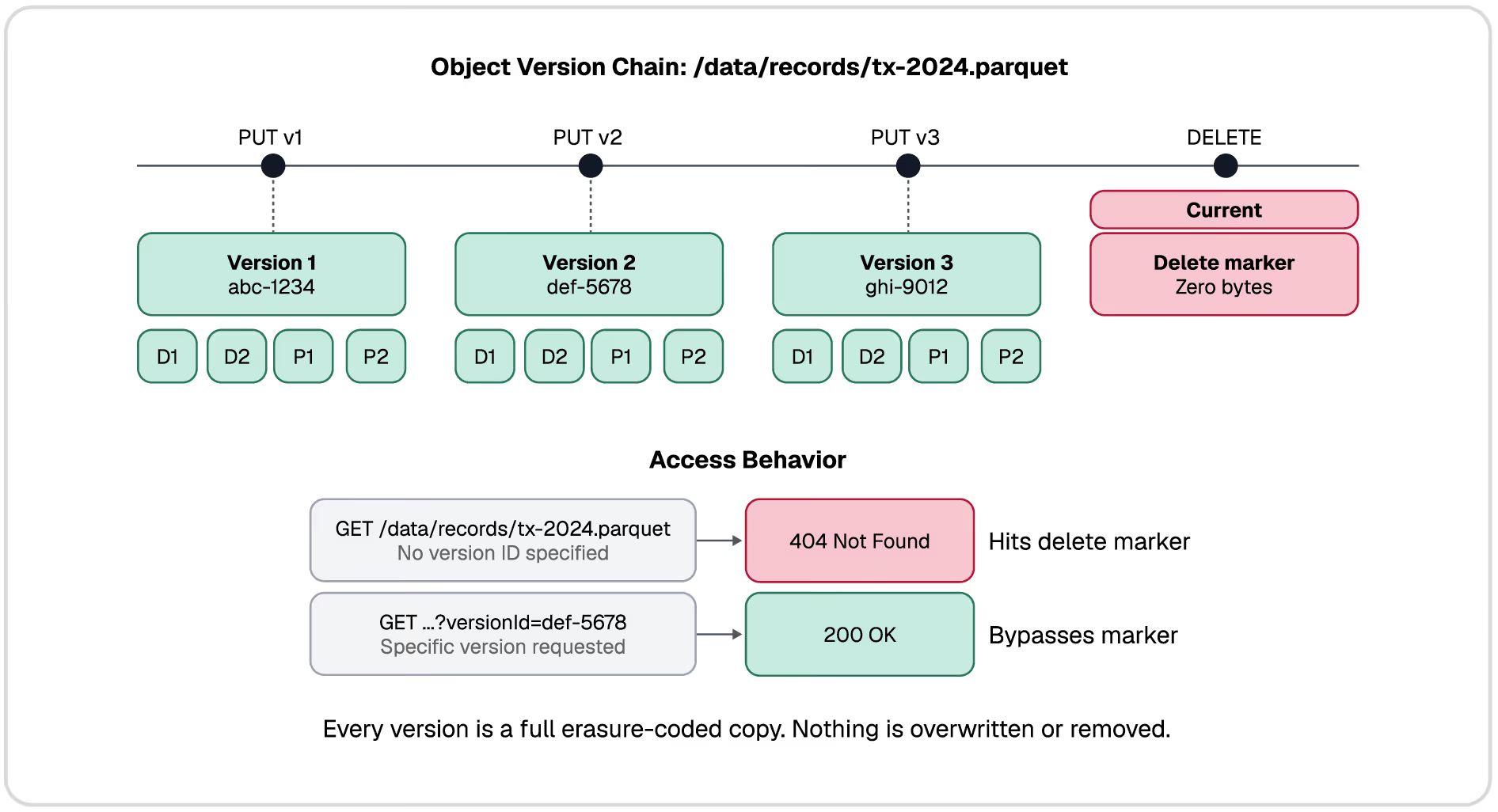
Immutable Architecture. Every PUT operation generates a new object version identified by a unique version ID. The previous version persists as an independent erasure-coded object with its own metadata entry, data shards, and parity shards. DELETE operations do not remove data. They insert a zero-byte delete marker that becomes the current version, hiding the object from standard LIST and GET operations while preserving every prior version intact.
Existing bytes are modified during writes or deletes. The integrity of every historical version is protected through the same bitrot detection and per-object checksums that govern current data, validated on every (read path.
Per-Prefix Granularity. Standard S3 versioning is bucket-level. All or nothing. AIStor extends this with per-prefix versioning exclusions, allowing administrators to enable versioning on a bucket while selectively suspending it for specific key prefixes. A financial services deployment can version transaction records and audit logs while excluding application temp files and session caches from version accumulation. Prefix exclusions evaluate at write time against in-memory configuration, adding negligible latency to the write path.
This granularity is operationally significant. Without it, administrators choose between versioning everything (absorbing the storage amplification of high-churn data that has no retention value) or versioning nothing. AIStor eliminates that tradeoff.
Recovery Without Infrastructure. Any previous version is retrievable by version ID. Restoring from accidental deletion or ransomware encryption is a metadata operation: remove the delete marker or GET the specific version. No tape archives. No backup software. No restore windows. RPO is effectively zero for any object written to a versioned bucket. The recovery path is the same API the application already uses.
Data Lifecycle Management
Versioning protects data. It also accumulates. Every overwrite creates a new version. Every delete adds a marker. Without automated governance, the protection mechanism becomes a storage cost problem. Lifecycle management is how administrators control that growth while enforcing retention policy across the entire namespace.
Continuous Policy Enforcement. In support of compliance, AIStor's lifecycle engine evaluates every object in the namespace against administrator-defined rules on a continuous background cycle. Rules specify filter criteria (key prefix, object tags, size thresholds), timing conditions (days since creation, days since becoming non-current, specific dates), and actions (expiration, storage class transition, delete marker cleanup, incomplete multipart upload abort). The scanner operates against the metadata index, not the data layer, making evaluation lightweight relative to the volume of data under management.
This is not a cron job that runs once a day. The scanner cycles continuously, picking up newly eligible objects as they age into policy scope. The distinction matters in environments where retention compliance is consistently and continuously measured in hours, not days.
Cross-Tier Transitions. Storage class transitions move objects between tiers without altering keys, version history, or metadata. AIStor transitions to any S3-compatible backend: remote AIStor clusters, third-party S3 providers, or on-premises cold storage targets. This is architecturally distinct from cloud lifecycle systems that restrict transitions to proprietary storage classes within the same provider. Objects remain accessible under the same key and version ID after transition, with GET requests transparently proxied to the destination tier.
Administrators can chain transitions across multiple tiers using rules with increasing day thresholds. Each transition is independent: removing an intermediate tier from the configuration does not strand objects already transitioned there.
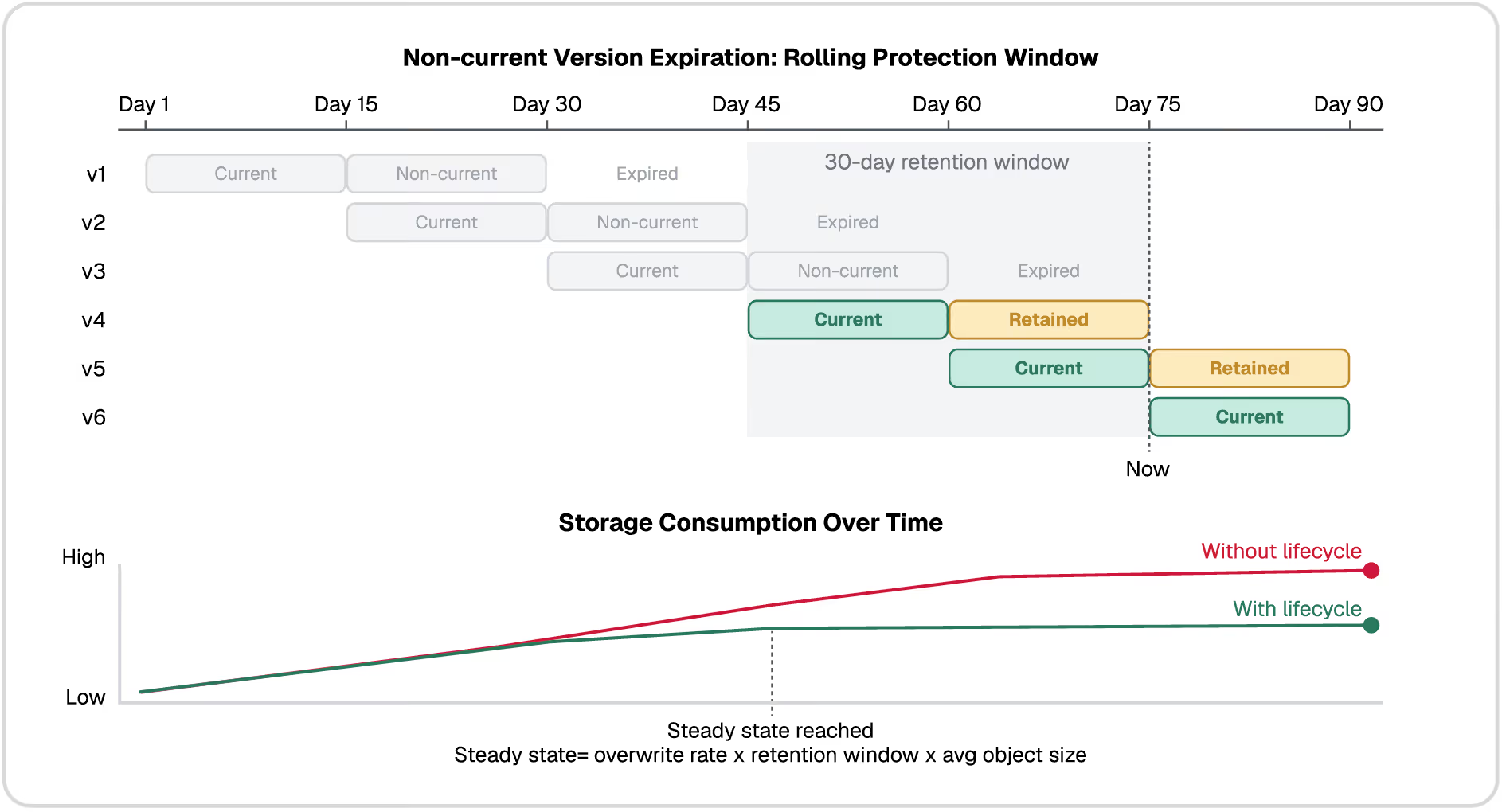
Non-Current Version Expiration. Pairing versioning with lifecycle expiration of non-current versions creates a rolling protection window. Current versions are always preserved. Non-current versions are retained for a configurable number of days. Versions older than the retention threshold are permanently deleted. Without this pattern, versioned buckets grow monotonically. With it, storage growth stabilizes at a predictable steady state driven by overwrite frequency, retention period, and average object size.
Failure Isolation. Failed lifecycle actions (destination unreachable, permission denied) skip the affected object and re-evaluate on the next scan cycle. Failures do not poison the queue or block processing of other objects. Every action attempted, succeeded, or failed is recorded in the audit log with the triggering rule and failure reason.
Data Inventory and Catalog
Data Lifecycle Management policies act on objects based on rules. Writing good rules requires knowing what is in the namespace: how many objects, how large, how old, what storage class, what encryption state. At petabyte scale, answering those questions through conventional means is itself an operational problem.
The ListObjects Problem. The ListObjects API is synchronous, paginated, and sequential. For namespaces containing billions of objects, a full enumeration takes hours or days, consuming API quota, holding connections open, and generating significant metadata read load on the cluster. Organizations running periodic compliance audits or feeding analytics pipelines from ListObjects are paying for an operation that does not scale.
Distributed Parallel Scanning. AIStor inventory jobs supplement ListObjects with asynchronous, distributed catalog generation. The namespace is partitioned by metadata index segments. Each cluster node processes its local segments in parallel, extracting metadata and streaming compressed output files to a designated destination bucket. A namespace walk that takes hours on a single thread completes in minutes when distributed across a multi-node cluster.
Structured Metadata Exports. Inventory outputs include object key, size, checksums, last modified timestamp, ETag, storage class, encryption status, version ID, replication status, and user-defined metadata tags. Output formats are CSV, JSON, or Parquet. Each export includes a manifest with record counts and checksums for downstream validation. This is the foundation for compliance reporting (proving what exists and how it is protected), capacity planning (analyzing growth trajectories), and operational hygiene (identifying orphaned data, policy gaps, or misclassified objects).
IAM-Enforced Boundaries. Inventory jobs execute with explicit IAM credentials that must have read access to the source and write access to the destination. If the job's credentials lack permission to list a specific prefix, those objects are excluded from the export. In multi-tenant environments, inventory jobs never leak metadata across tenant boundaries. This is access control by design, not by configuration exception.
Inline Compression
Inventory tells administrators what they have. Compression reduces how much space it consumes. In most storage environments, compression is a separate process that runs after data lands on disk. AIStor handles it differently.
Write-Path Integration. AIStor compresses objects during the write path, between client data receipt and erasure-coded shard generation. The server evaluates each object's content type against the bucket's compression configuration. Matching objects pass through the MinLZ codec before erasure coding splits the compressed stream into data and parity shards. Data is stored compressed from the first byte on disk. There is no post-processing batch job, no delay between upload and space savings, and no window where uncompressed data consumes capacity. Decompression is transparent on read. Clients see original bytes without any awareness that compression occurred.
MinLZ Performance Profile. MinLZ prioritizes compression and decompression throughput over maximum ratio. This is the correct tradeoff for a primary storage system where read and write latency directly impact application performance. Text-based workloads (logs, CSV, JSON, XML) see substantial space savings with marginal write latency overhead. Pre-compressed or encrypted content (JPEG, MP4, AES-encrypted blobs) is excluded via MIME type configuration to avoid wasting CPU cycles on data that will not compress.
Erasure Coding Compounding. Because compression executes before erasure coding, savings apply to both data and parity shards. An object that compresses 2:1 requires half the raw capacity for its data shards and half for its parity shards. This makes compression particularly effective in high-parity configurations where erasure coding overhead represents a larger percentage of total capacity.
Observability and Operational Control
Versioning, lifecycle, inventory, and compression run continuously in the background. Four subsystems executing autonomously require a single operational surface where administrators can easily and quickly verify that policies are enforcing correctly, capacity trends match expectations, and every action is auditable.
Unified Audit Log. Every data management operation, version creation, lifecycle transition, inventory job execution, compression decision, is recorded in a single audit stream. Entries include the principal identity, the specific policy or configuration that triggered the action, timestamps, object identifiers, and outcome status. Administrators monitor one log, not four. Compliance teams prove governance from one source, not a correlation exercise across vendor boundaries.
Prometheus-Compatible Metrics. AIStor exposes operational metrics for each data management subsystem through its Prometheus-compatible endpoint: version count growth rate per bucket, lifecycle actions executed per scan cycle (broken out by action type and success/failure), inventory job duration and object count, and compression ratios by bucket and content type. These metrics integrate directly with existing Grafana dashboards, alerting pipelines, and capacity planning tools without custom exporters or polling scripts.
Operational Visibility into Policy Execution. Storage administrators can validate that lifecycle policies are executing as designed by monitoring transition and expiration rates against expected object aging curves. A sudden drop in lifecycle actions may indicate a misconfigured rule or a permissions change that silently broke policy evaluation. A compression ratio trending toward 1:1 signals a shift in workload composition that warrants reviewing the MIME type configuration. The metrics surface makes these conditions observable before they become operational problems.
Deployment Guidance
The capabilities above are production-ready out of the box, but deploying them well requires planning around the interactions between subsystems. Versioning drives capacity. Lifecycle controls that capacity. Inventory validates the result. Compression shifts the ratio. Getting the configuration right across all four determines whether data management runs on autopilot or generates operational noise.
Capacity Planning with Versioning. Each object version is a full copy, not a delta. Capacity modeling must account for overwrite frequency, average object size, and the non-current version retention period configured in lifecycle rules. For write-heavy workloads with short retention windows, steady-state version overhead is modest. For compliance environments with multi-year retention and large objects, version storage can exceed the capacity consumed by current data. Plan accordingly and monitor version count growth through the metrics endpoint.
Lifecycle Policy Hygiene. Every prefix in the namespace should be covered by an explicit lifecycle rule. Unmanaged prefixes accumulate data indefinitely. A production-grade lifecycle configuration includes expiration for ephemeral data, transitions for aging data, non-current version expiration for versioned buckets, delete marker cleanup, and incomplete multipart upload abort with a reasonable timeout. Test policies against a representative namespace subset before applying them to production buckets.
Inventory Scheduling. Inventory frequency should match operational need. Daily schedules suit compliance-driven environments or pipelines that consume metadata exports. Weekly schedules are appropriate for capacity trending and audit preparation. In very large namespaces (billions of objects), baseline job duration during initial deployment to ensure jobs complete within their scheduled window without overlapping subsequent runs.
Compression Tuning. Enable compression for known-compressible MIME types. Leave it disabled for pre-compressed and encrypted content. Baseline compression ratios on representative data before factoring savings into capacity plans. Monitor the logical-to-physical size ratio in production to validate that compression delivers expected returns as workload composition evolves.
Why MinIO AIStor
AIStor collapses data management into the storage platform where it belongs. Versioning with per-prefix control. Lifecycle policies that enforce continuously across any S3-compatible tier. Inventory that catalogs exabyte namespaces in minutes with full IAM enforcement. Compression that saves capacity from the first byte written. Observability that makes every policy decision visible through a single metrics surface and audit stream.
One platform. One policy model. One place to prove compliance.