Purpose-Built Context Memory Store for AI Inference
MinIO MemKV delivers transformative improvements to both TTFT (Time to First Token) and TPOT (Time Per Output Token) in AI inference workloads by providing petascale, native flash-based context memory accessed end-to-end over 800 GbE RDMA.
Designed exclusively for AI inference and built from the ground up for the G3.5 layer of the GPU memory hierarchy.
Native to NVIDIA STX® Infrastructure
Runs directly on NVIDIA STX-based systems accelerated by NVIDIA Vera CPUs to support high-speed context retrieval and intelligent data movement.
End-to-End RDMA Transport
KV cache moves from GPU memory to NVMe over RDMA, bypassing file system and object protocols entirely. No CPU in the data path, no protocol translation overhead.
GPU-Native Block Sizes
Operates in 2–16 MB blocks optimized for throughput-oriented GPU access patterns, not the 4 KB blocks designed for legacy storage workloads.
Petascale KV Cache Capacity
Deploy petabytes of G3.5 KV cache across the inference cluster, virtually eliminating redundant prefill computations and significantly improving GPU efficiency.
Wire-Speed Fabric Performance
Built for NVIDIA Spectrum-X 800 GbE networking and PCIe Gen6, driving throughput to near wire speed across the physical fabric.
Elastic Independent Scaling
Scale GPU compute and shared context memory independently. Add KV cache capacity without provisioning additional GPU nodes, and vice versa.
Why MemKV is Different
Conventional inference architectures store KV cache in per-GPU HBM, which is a scarce, expensive resource that forces a hard tradeoff: keep context in memory and starve the model, or evict it and pay the recompute penalty on every request. Neither path is acceptable at scale. MemKV eliminates the tradeoff by placing a petascale, flash-backed KV pool at the correct layer of the memory hierarchy, accessed over RDMA without touching a file system or object protocol.
G3.5 Native, Not Retrofitted
Lives at the correct layer between GPU HBM and object storage, not an appliance bolted onto existing infrastructure after the fact.
RDMA From GPU to NVMe
Data moves from GPU memory to flash over RDMA with no file system, no object protocol, and no CPU in the critical path.
Shared Pool Across the Cluster
Every inference node draws from the same petascale KV store, eliminating per-GPU recomputation as a recurring cost.
Single Binary in the Storage Tier
Runs as a single binary directly on NVIDIA STX-based systems, accelerated by NVIDIA Vera CPUs.
Business Impact
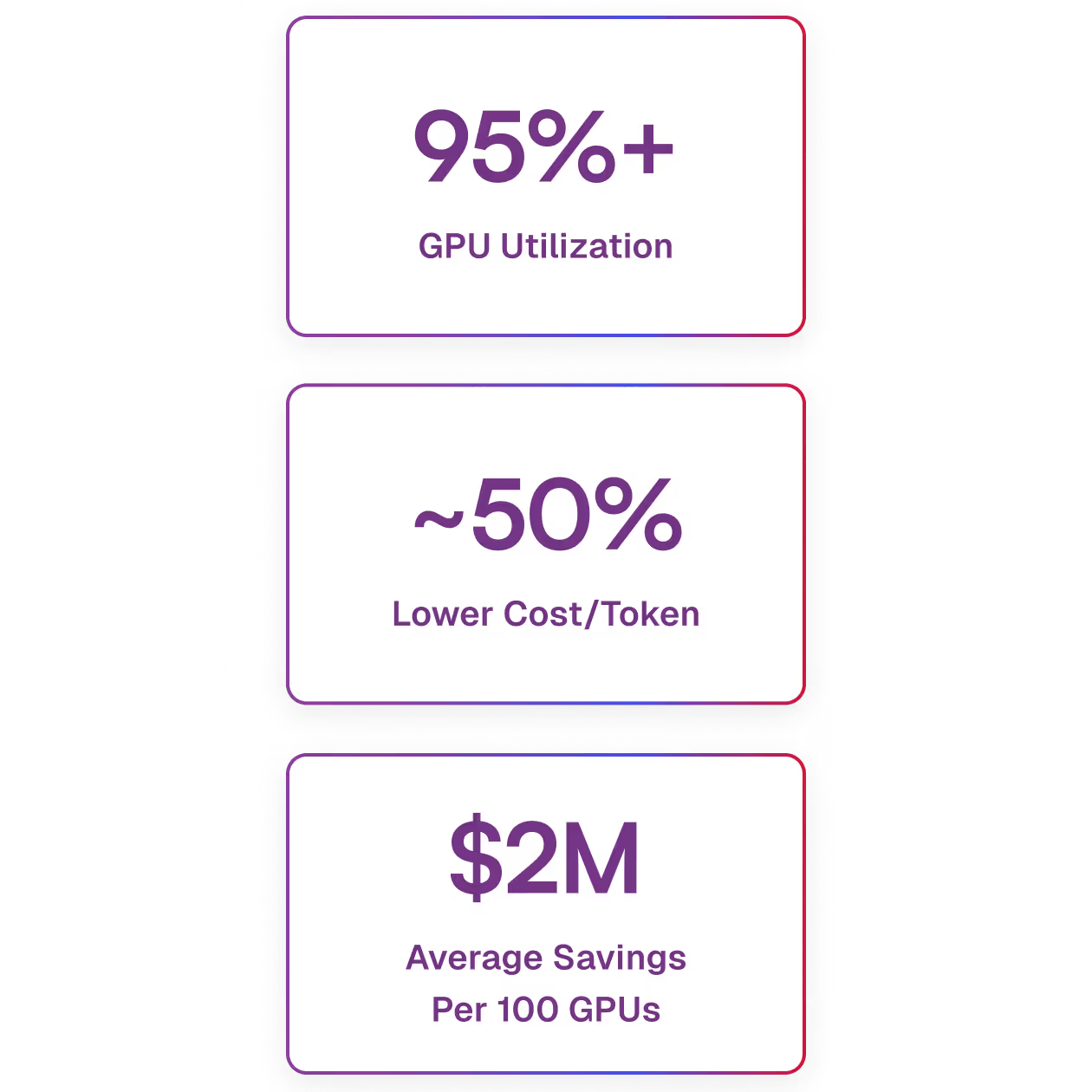
95%+ Sustained GPU Utilization
GPUs stop wasting cycles on context recomputation and run token generation at full throughput. Utilization above 95% is sustained across the cluster, not a single-node peak.
40-60% Lower Cost Per Token
Eliminating over-provisioned GPU memory and recompute cycles cuts production cost per token by 40–60% in inference clusters. GPU compute and context memory scale independently.
Reduced Power and Operational Overhead
Flash NVMe and RDMA consume a fraction of the energy required by DRAM-scale systems or recomputation-heavy clusters. Cooling and data-center footprint shrink accordingly; power savings alone can cut OpEx by tens of percent at scale.
100x Agentic Scale for Enterprises
Multi-step agentic tasks that previously required prohibitive GPU memory now run at 100x scale with consistent response times. Long-context workloads become economically viable in production.
Shared Memory Tier for Model Providers
A single petascale pool replaces per-GPU cache fragmentation, combining microsecond responsiveness with petabyte-scale capacity across the entire serving infrastructure.
Ready to See It in Action?
Get MemKV running in your environment. Talk to our team today.




.svg)

