White Paper

MemKV Datasheet

About This Resource
Simple maroon user profile icon with circular head and curved shoulders.
Who This is For:

AI platform architects, ML infrastructure leads, and inference platform owners evaluating how to cut GPU recompute costs and raise effective utilization on clusters running long-context, high-concurrency, or multi-node inference workloads.

Key Takeaways
Blue check mark inside a light blue circle.

When GPU memory runs out, evicted context triggers full prefill recomputation. In production deployments, more than half of all GPU cycles go to rebuilding context the cluster already paid for, and utilization dashboards can't tell recompute apart from real token generation.

Blue check mark inside a light blue circle.

MemKV fills the G3.5 tier the memory hierarchy was missing: a shared, cluster-wide KV cache pool between local GPU/CPU memory and durable object storage, reached over RDMA at microsecond speed and petabyte scale, on standard NVMe flash.

Blue check mark inside a light blue circle.

Recovering those cycles holds effective GPU utilization near 90%, cuts cost per token 40 to 60%, and puts a petabyte of context memory at under $80,000, all without touching GPU compute or rewriting the application.

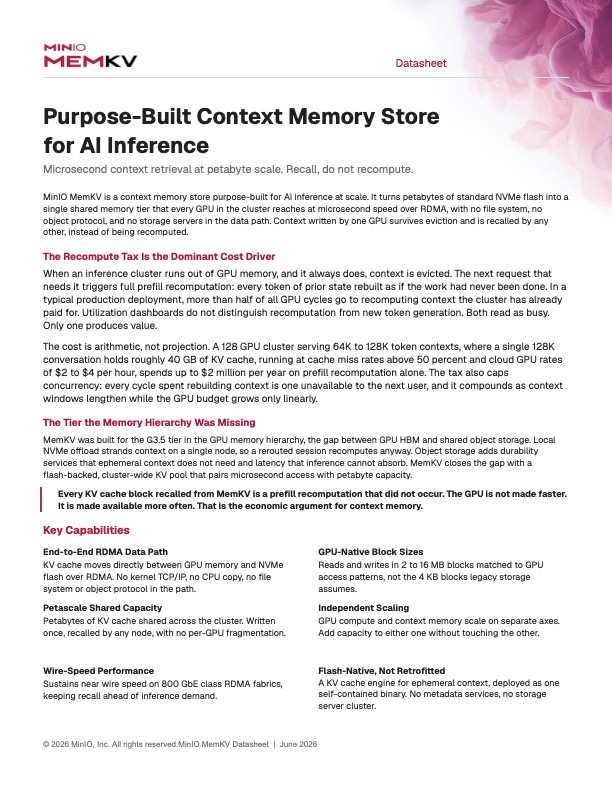
Inference clusters pay a recompute tax every time context gets evicted from GPU memory, and at scale that tax runs into the millions annually while capping how many concurrent sessions a cluster can serve. MinIO MemKV closes the gap between GPU HBM and object storage with a flash-backed, RDMA-native KV cache tier that's shared across every node in the cluster: context written by one GPU survives eviction and is recalled by any other instead of being rebuilt from scratch. This datasheet covers where MemKV sits in the inference memory hierarchy, how context moves on write and recall, the economics behind the recompute tax, and where MemKV earns its place: agentic workflows, long-context coding assistants, and multi-turn services where sessions migrate across nodes. MemKV joins AIStor as the second pillar of the MinIO data foundation, one platform spanning objects, tables, and live inference context.

Related Resources