.svg)


Building the AI-Native Data Foundation for Enterprise and Sovereign AI
HUMAIN and MinIO have entered a strategic engineering and go-to-market partnership, intending to build the world's most advanced AI-native platform and enable enterprises to unlock the full value of their data in the age of autonomous AI agents. The first milestone is HUMAIN Fabric, HUMAIN's AI-native unified data platform, with MinIO leading its architecture, design, and development.
The Data Problem in the Age of AI
Enterprise data did not get harder to store. It got harder to reason over. Most estates were assembled one system at a time, and every addition solved a problem while adding a boundary.
Fragmentation. Multiple data services create incompatible silos in proprietary formats. Unification happens at the data layer or not at all, and what is left is a data swamp.
Governance by agreement. Identity, access, classification, and lineage live as agreements across systems rather than properties of one place. Every path is secured separately, and every added component is one more thing to secure forever.
Staging built for people. Medallion pipelines stage raw data through cleaned and curated tiers so human teams get business-ready tables. The staging was a necessity for humans, and it carries duplication and pipelines to sync.
A stack built for data teams, not agents. The estate was designed for people querying data and building pipelines by hand. Agents must reason over governed data directly, inside the same boundary as everyone else, and most estates cannot let them.
Why AI Needs a Common Data Foundation
Unification has to happen at the data layer.
One foundation means one identity and access boundary, and governance and lineage become properties of a single place rather than agreements across systems. Enforcement lives with the data, so access, classification, and audit hold on every path, including the paths agents take. Raw data stays the master and curated views generate on demand, so intermediate copies disappear. Compute stays separate and ephemeral, so no engine becomes a permanent dependency. And with data, compute, keys, and governance inside the customer’s boundary, the foundation holds sovereign data in-country.
The Partnership
The future of AI will not be defined by individual models or isolated applications. It will be defined by integrated platforms that unify infrastructure, compute, data, memory, models, agents, and intelligent applications into a single operating ecosystem. MinIO is now HUMAIN’s data and memory foundation partner, beginning with HUMAIN Fabric, HUMAIN Brain, and HUMAIN ONE, the models and products layer within the HUMAIN AI Stack.
Strategic engineering
Co-developing next-generation AI-native platform capabilities for HUMAIN, combining HUMAIN’s vision for sovereign, AI-native data infrastructure with MinIO’s expertise in high-performance object storage and persistent memory.
Joint R&D and co-development
Starting with HUMAIN Fabric, the strategic foundation for HUMAIN ONE, HUMAIN OS, HUMAIN Brain, and HUMAIN Create.
Global go-to-market
Deployments begin in Saudi Arabia before expanding with HUMAIN’s international growth, supporting organizations that need secure, scalable, production-ready AI infrastructure.
Chief Executive Officer, HUMAIN

HUMAIN Fabric
HUMAIN Fabric is an AI-native data platform that enterprises and public-sector organizations deploy to power enterprise and sovereign AI, turning their data into a single governed foundation that any agent can reason over. It provides the persistent memory, governance, and data services that AI factories, foundation models, intelligent applications, and autonomous agents require, enabling AI systems to act on enterprise and government knowledge while maintaining sovereignty, performance, and traceability.
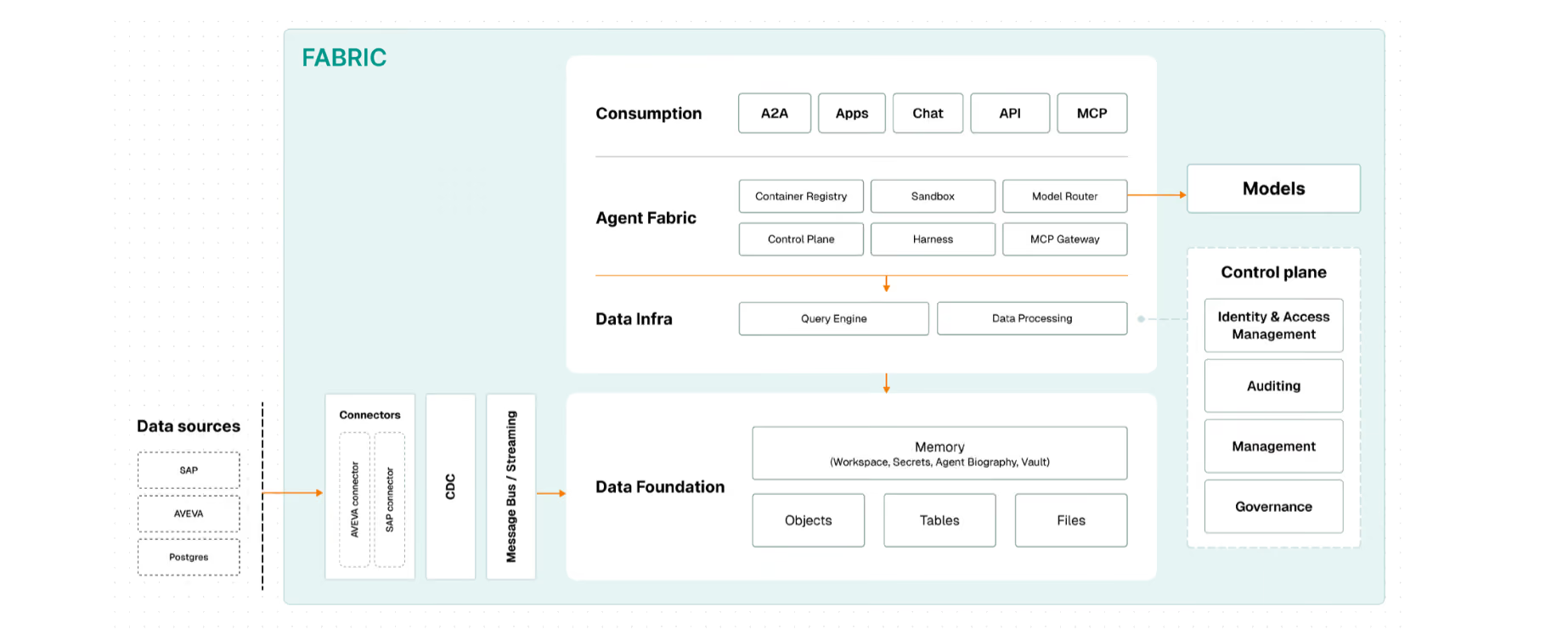
TOne Governed Foundation
Objects, tables, and files. Data lands once and stays as the system of record, with tables in open Apache Iceberg format. Agents produce curated views on demand rather than as standing stages, so results arrive without intermediate copies.
Memory. The foundation holds what agents learn rather than re-retrieving raw context on every query, so understanding accumulates instead of starting cold. Because that memory lives inside the foundation, the same boundary controls access to it.
Connectors and streaming. A deliberately minimal connector set brings sources in through change data capture and a streaming message bus. Records are processed on arrival, so time-sensitive work happens immediately while the full history lands as the durable record.
Governance and sovereignty. Classification, PII sensitivity, lineage, and audit resolve with access at the data layer, so they hold on every path. Fabric is self-hostable in-country with no required external SaaS, and identity stays with the customer’s provider.
TIntelligence in Practice
Ask.
A question about a machine returns its current reading, its direction, and the team’s own thresholds. Answers label what is measured versus estimated, and where there is no history, Fabric says so.
Investigate.
A question with no answer yet opens an investigation and puts agents on it, returning analysis, economics, and whether the outcome was avoidable, recomputed against the latest data.
Operate.
When an expired certificate stopped an import, Fabric diagnosed the fault, held the queued batches, filed the renewal request, and stopped rather than fabricating data or dropping records.
Built for AI at scale.
Training data and artifacts on one foundation, inference against live state rather than a stale summary, retrieval limited to approved knowledge, and agentic work building on what came before.
About
HUMAIN, a PIF company, is a global artificial intelligence company delivering full-stack AI capabilities across four core areas: next-generation data centers; hyper-performance infrastructure and cloud platforms; advanced AI models, including some of the world’s most advanced Arabic large language models developed in the Arab world; and transformative AI solutions combining deep sector insight with real-world execution.
About
MinIO is the data and memory foundation for enterprise AI. AIStor and MemKV unify every layer of the data stack, from agentic AI and inference context memory to tables and objects across core, edge, and cloud. Each layer is built for the speed, scale, and economics that AI and analytics demand. Trusted by 77% of the Fortune 500, MinIO is redefining how AI factories, intelligent applications, and autonomous agents secure, persist, and unlock the full value of their data.