
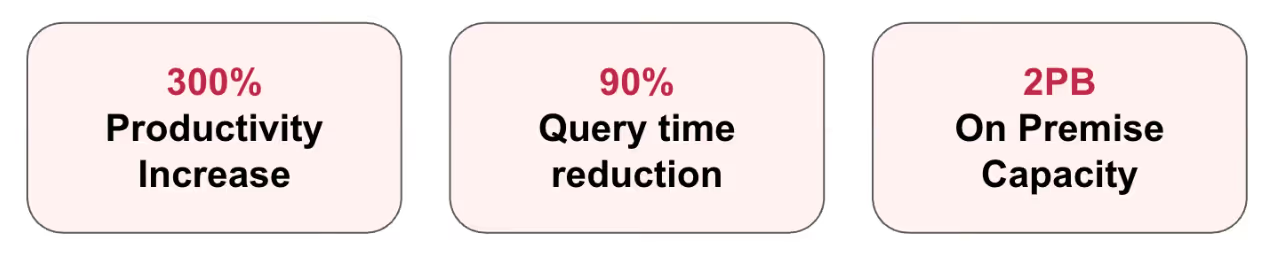
A West African subsidiary of the Orange Group replaces legacy Hadoop infrastructure with a high-performance, on-premise MinIO AIStor data lakehouse, reducing compliance query times from hours to minutes, achieving a 300% productivity increase, and establishing a replicable model for group-wide expansion across Africa, France, and EMEA.
Orange Côte d’Ivoire is a leading telecommunications provider serving millions of customers in Ivory Coast, and a key subsidiary of the Orange Group, one of the world’s largest telecom operators with more than 1,000 employees in-country and operations spanning Africa, France, and the broader EMEA region.
The company’s data platform serves data scientists, data engineers, DevOps teams, and big data administrators who depend on fast, reliable access to large datasets for fraud detection, compliance reporting, customer analytics, and operational intelligence. As a key node in the Orange Group’s pan-African and European strategy, Ivory Coast was selected as the deployment site for a new data lakehouse initiative, one intended to serve as a replicable model for the rest of the group.
Orange Côte d’Ivoire’s data infrastructure had been built on Hadoop/HDFS, a technology that served the business in its early data years but had become a significant operational constraint as data volumes grew and business demands evolved.
The most visible symptom was compliance and fraud detection. Queries that needed to run fast to detect fraud, meet regulatory deadlines, and support real-time decision-making, were taking hours on Hadoop. The delay created direct regulatory exposure and limited the speed at which the business could respond to emerging threats.
At the same time, the data engineering team was spending the majority of their time responding to extraction requests from business units. There was no unified data access layer: queries had to be sent to different systems separately, creating a bottleneck that consumed engineering capacity and left little room for higher-value work such as AI model development and advanced analytics.
Technically, Hadoop’s tightly coupled compute and storage architecture meant neither layer could be scaled independently. Adding capacity required scaling both simultaneously, driving up costs. HDFS’s 3x replication overhead also reduced usable storage per hardware unit significantly compared to modern erasure-coded alternatives. And the absence of an S3-compatible API meant that modern analytics tools, including the SQL query engine the team wanted to deploy, could not be integrated without significant re-architecture.
Bringing new hardware online added a further layer of complexity. The initial deployment of Dell servers required expert guidance to configure the OS and mount XFS filesystems without RAID, a step that required skills the team did not have in-house and that became a bottleneck during the initial rollout phase.
Orange Côte d’Ivoire selected MinIO AIStor as the storage foundation of their new on-premise data lakehouse. AIStor is a high-performance, S3-compatible object store that is software-defined, deployable as a single binary on commodity hardware, with no external dependencies and no proprietary appliances required.
The deployment runs on Dell hardware across two sites, with four nodes and twenty NVMe drives (15.36TB each) per site, delivering 1PB of capacity per site and 2PB in total. Starburst Enterprise sits above AIStor as a unified SQL query layer, giving data scientists, analysts, and business users self-service access to all data sources through a single endpoint, without needing to know where the data lives or send requests to multiple systems.
The deployment is backed by a MinIO SUBNET subscription, which gives the Orange Côte d’Ivoire team direct, engineer-to-engineer access to the MinIO engineers who built AIStor, 24 hours a day, seven days a week, 365 days a year. This was critical during the initial deployment phase, where SUBNET support resolved the XFS filesystem configuration challenges that had blocked progress, and provided the team with the knowledge transfer they needed to manage and extend the platform independently.
AIStor’s software-defined architecture decouples compute from storage, enabling each layer to scale independently based on workload demand. Its erasure coding approach delivers significantly more usable storage per hardware unit than HDFS’s 3x replication model. And its S3-compatible API enabled immediate integration with Starburst Enterprise, while also laying the groundwork for future AI and machine learning workloads, including native Apache Iceberg table support for open lakehouse architectures.
The impact on the data engineering team was immediate. Compliance and fraud detection queries that had previously taken several hours on Hadoop now run in minutes on the AIStor-backed lakehouse. The team achieved a 300% increase in productivity as engineers were freed from the constant stream of manual extraction requests and redirected to higher-value work: AI model development, advanced analytics, and the ongoing evolution of the data platform.
The deployment also validated the strategic business case. Orange Côte d’Ivoire now operates a modern, scalable, on-premise data lakehouse that is S3-compatible, software-defined, and built on commodity hardware. The architecture is straightforward to replicate and that is precisely the intention. The Orange Group is planning to use the Ivory Coast deployment as the documented proof point and replicable template for rolling out the same model to other group entities across Africa, France, and EMEA. A whitepaper is in progress to formalise the deployment approach for group-wide use.
Looking ahead, the open, S3-compatible foundation built on AIStor positions the organisation to extend beyond its current analytics workloads. Native Iceberg table support enables structured and unstructured data to coexist in a single lakehouse architecture, and the platform’s linear scalability and high-throughput design means that as AI and machine learning initiatives mature within the Orange Group, the storage infrastructure will be ready to support them without re-architecture.
This Case Study was derived from this original article: Improving efficiency and productivity with lakehouse analytics by Starburst




.svg)