.svg)



Part 1 of a three-part series on prompt caching, prefix caching, and shared context memory for AI inference.
Every enterprise AI strategy eventually runs into the same question: why does an expensive GPU fleet spend so much time rereading context it has already seen?
That question matters for the C-suite because it is not a model-quality issue. It is an operating-margin issue.
Modern AI applications are context heavy. A coding assistant carries project rules, tool definitions, repository summaries, previous command output, and the developer's original request. A support agent carries policies, product catalogs, customer history, retrieval results, and guardrails. A financial assistant carries reports, schema definitions, risk language, and audit rules.
Most of that context is repeated. Only the newest question or newest tool result changes.
If the serving system processes the repeated portion from scratch on every turn, the business is paying premium GPU dollars for duplicate work. Adding more GPUs can hide the queue for a while, but it does not remove the repeated prefill cost. Prompt caching matters because repeated context should become reusable infrastructure, not recurring GPU expense.
Why this is becoming an enterprise issue now
The timing matters. Enterprise AI is moving from isolated chat tools to agentic systems that call tools, read enterprise data, write code, inspect transactions, and take multi-step actions. Gartner expects 40% of enterprise applications to include task-specific AI agents by the end of 2026. Google Cloud's 2026 infrastructure survey says 83% of surveyed IT leaders expect to upgrade infrastructure for production-grade agentic AI.
That adoption changes the cost model. Ramp Economics Lab has started tracking AI intensity, not just AI adoption, across subscriptions, coding agents, and token/API usage. Ramp's recent analysis says average monthly token spend rose 13x from January 2025 to January 2026, and that AI costs spike 50% or more in about one of every four months for the biggest spenders. In plain English: companies are learning that the unit of work is no longer just a seat, a server, or a contract. It is also tokens, context, and repeated reasoning steps.
The leading engineering teams are responding with architecture. Uber has described a Gen AI Gateway that gives teams one governed path to external LLMs and in-house hosted open-source LLMs, with logging, auditing, cost guardrails, attribution, policy controls, and PII redaction. DoorDash shows the same pattern from several angles: its Assistant platform uses a unified model factory with provider fallback and per-role model swaps, SafeChat combines internal and external models, and a recent personalization pipeline trims consumer memory blocks to the exact sub-blocks needed for each use case, both to control token cost and to avoid irrelevant context that can degrade output quality.
This is the pattern business leaders should notice. The answer is not "use less AI." The answer is governed model routing, context discipline, and reuse. Prompt caching is the reuse part of that equation.
It also explains why simply increasing context windows is not enough. Anthropic's agent guidance treats context as a finite resource that has to be managed across multi-turn work. Chroma's Context Rot research shows that model performance can become non-uniform as input length grows. Long context is useful, but indiscriminate context is still expensive and can become less reliable.
Sovereign AI makes the same point from a control perspective. McKinsey frames sovereign AI as the ability to develop and control AI capabilities in alignment with local laws, values, and strategic requirements. Deloitte puts it more directly: where AI runs is becoming as important as what AI does. For enterprise buyers, that means reusable context should not be treated as throwaway traffic. It is part of the AI operating model.
The terms in plain English
The industry uses a few overlapping terms. They are easier to understand when we map them to business questions.
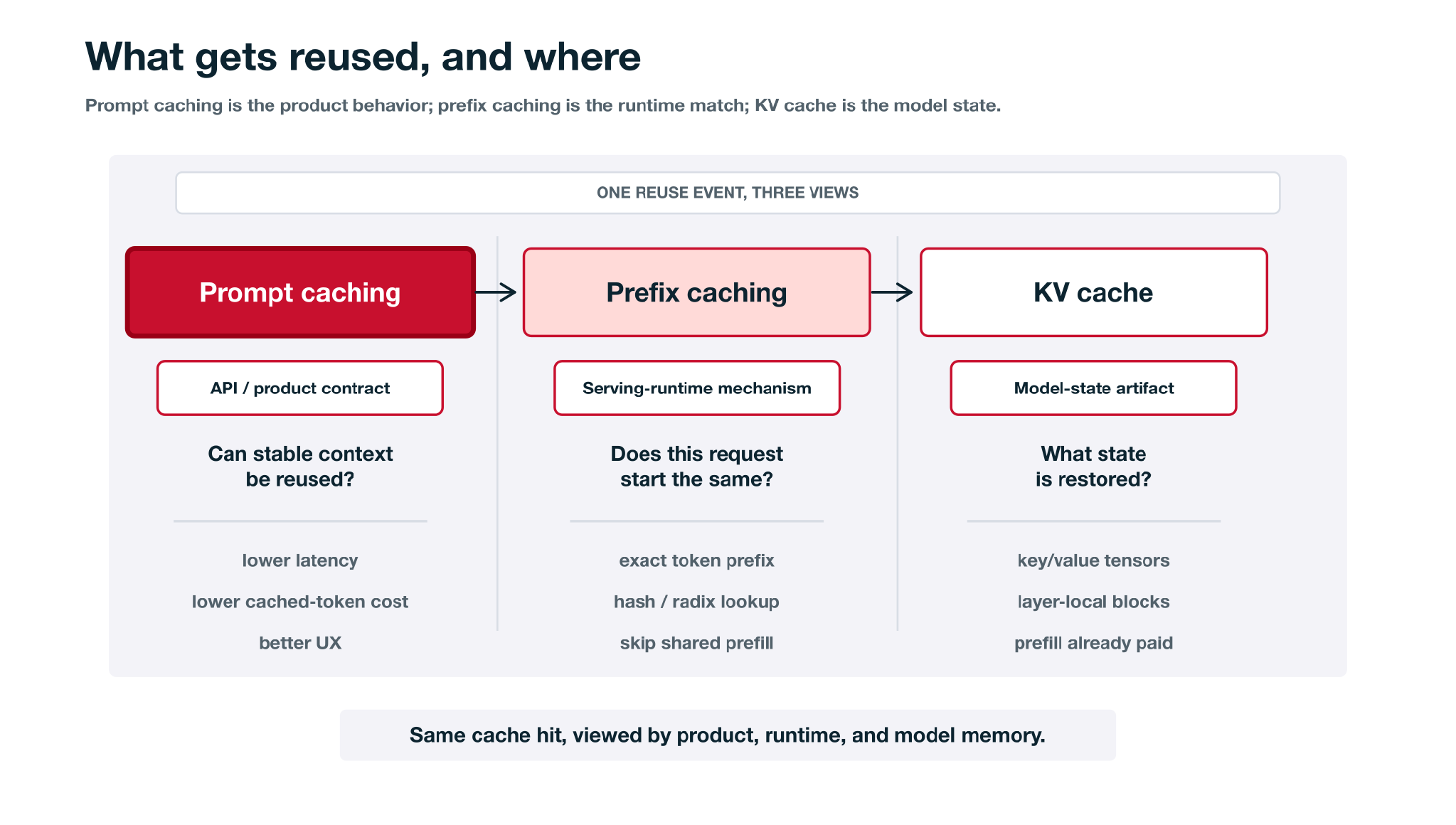
Prompt caching is the product or API feature. It means stable prompt content can be reused across requests. For a buyer, this shows up as lower latency, lower input-token cost where providers expose cached-token pricing, and better user experience for applications that repeat long instructions or documents.
Prefix caching is the serving-engine mechanism. It means the inference server recognizes that two requests begin with the same token sequence and reuses the work already done for that shared beginning. This is the runtime version of prompt caching.
KV cache is the model state being reused. When the model reads a prompt, it builds temporary attention state, called key/value or KV state, so later tokens can refer back to earlier ones. Reusing that state lets the model avoid recomputing the same prompt prefix.
KV cache offload is what happens when that reusable state is too large to keep only in GPU memory. It can move to host memory, local flash, or a shared context memory tier.
The simplest summary is this: prompt caching is what the application wants, prefix caching is how the inference runtime finds reuse, and the KV cache is the expensive intermediate state the system should not rebuild.
Why business leaders should care
Prompt caching affects three executive metrics: customer experience, GPU economics, and infrastructure scalability.
The customer metric is time to first token, often shortened to TTFT. Users do not experience a GPU utilization chart. They experience the wait before the first word appears. Long prompts make that wait prefill-heavy. If the prompt is mostly repeated, recomputing it is avoidable latency.
The economics metric is useful GPU work per dollar. A GPU can be busy and still be wasteful. If it is rebuilding the same system prompt, tool schema, or document context again and again, the utilization number may look healthy while the margin picture gets worse.
The scalability metric is memory pressure. Long-context AI creates large KV caches. GPU HBM is fast and expensive, but it is not infinite. As concurrency increases, the system either pins sessions to GPUs, evicts reusable state and recomputes it later, or moves that state into a larger tier.
For long repeated prefixes at fleet scale, the third option is the one that scales beyond a single worker.
That larger tier cannot behave like ordinary enterprise storage. Object, file, SAN, and NAS systems are built for durable data management, policy enforcement, metadata, and broad compatibility. Those are valuable properties, but they are not the same thing as a hot context-memory tier. Prompt caching needs a memory path: low-latency movement of large KV blocks so the GPU can skip repeated prefill work.
The coding-agent example executives already understand
Coding assistants make the value easy to see.
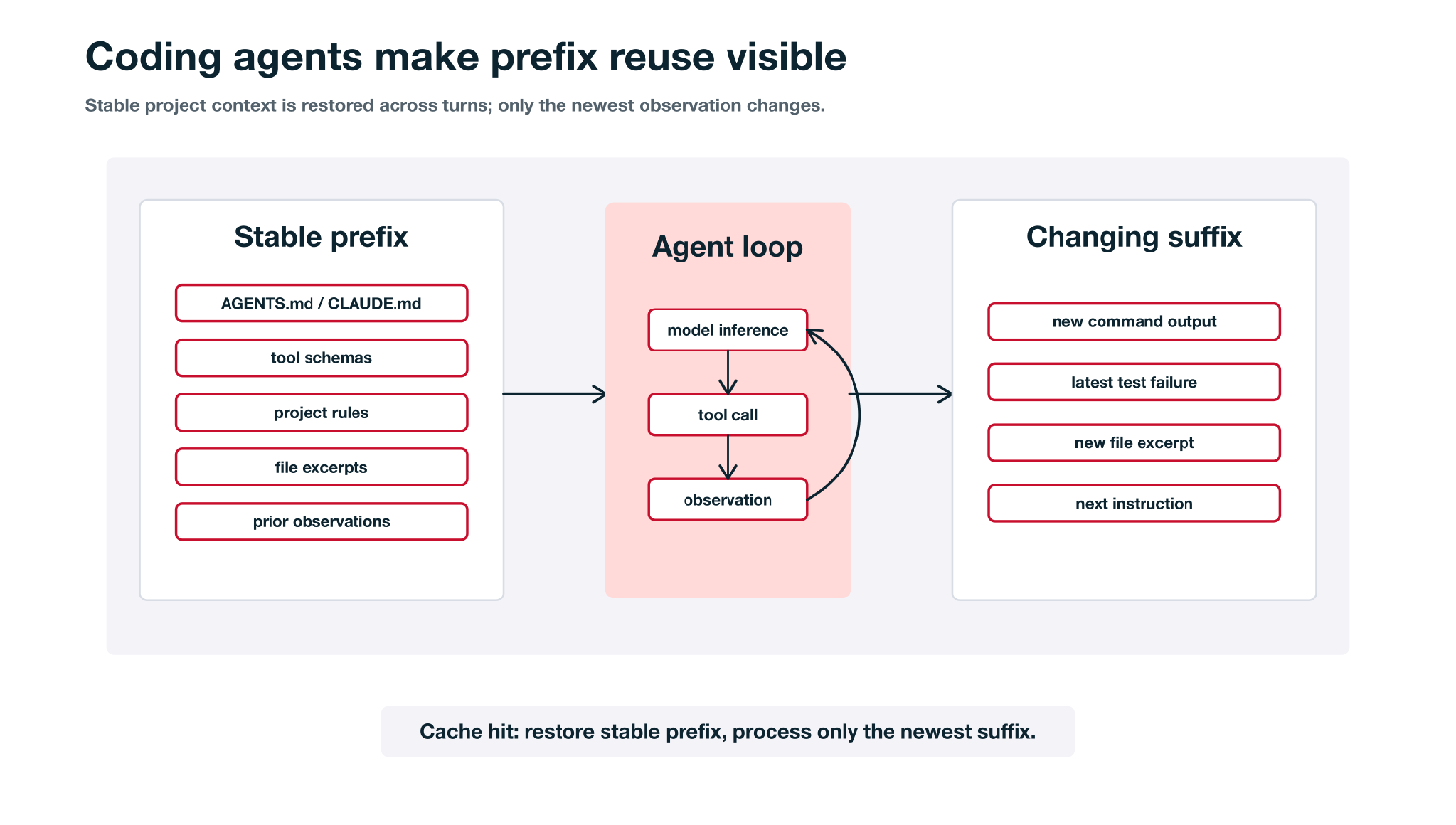
Claude Code, Codex, OpenCode, and similar tools run as agent loops. The assistant reads files, calls tools, runs commands, receives observations, and asks the model what to do next. Each step is another inference request.
But the request is not brand new every time. It carries stable project context:
- Repository rules such as AGENTS.md or CLAUDE.md.
- Tool descriptions and MCP server definitions.
- Build and test conventions.
- The original task.
- Files already inspected.
- Prior command output that remains relevant.
Only the latest suffix changes: a new test failure, a new file excerpt, or the next user instruction.
That repeated prefix is not theoretical. It is the actual work developers pay AI systems to process all day. Without caching, each turn can force the system to reprocess the same project context. With caching, the stable prefix is processed once and reused.
Why buying more GPUs is not enough
More GPUs increase capacity, but they do not automatically increase reuse.
If every request recomputes the same prefix, a larger fleet mostly gives you more places to do duplicate work. The queue may shrink, but cost per useful unit of work remains higher than it needs to be.
The better question is not "how many GPUs do we need?" It is:
- How much of our prompt traffic is repeated?
- How long are the repeated prefixes?
- How often do repeated prefixes get evicted from local GPU memory?
- How much P99 TTFT comes from avoidable prefill?
- Can replicas share reusable context, or is cache locality trapped inside one worker?
These are infrastructure questions. They connect directly to AI gross margin, SLA design, and customer experience.
Where this series goes next
Part 1 makes the business case. The rest of the series goes one layer deeper at a time.
- Part 2: When Repeated Context Becomes an Infrastructure Problem. How repeated context becomes a memory hierarchy problem once GPU memory, routing, eviction, and concurrency enter the picture.
- Part 3: From Cache Hits to Production SLAs. A buyer and operator scorecard for proving that shared context memory improves tail latency, concurrency, and cost per useful token
.svg)