.svg)


.jpg)
A destructive proof of AIStor Memory Workspace continuity.
Most agent demos end after the answer appears. This one ends the process before the answer is finished.
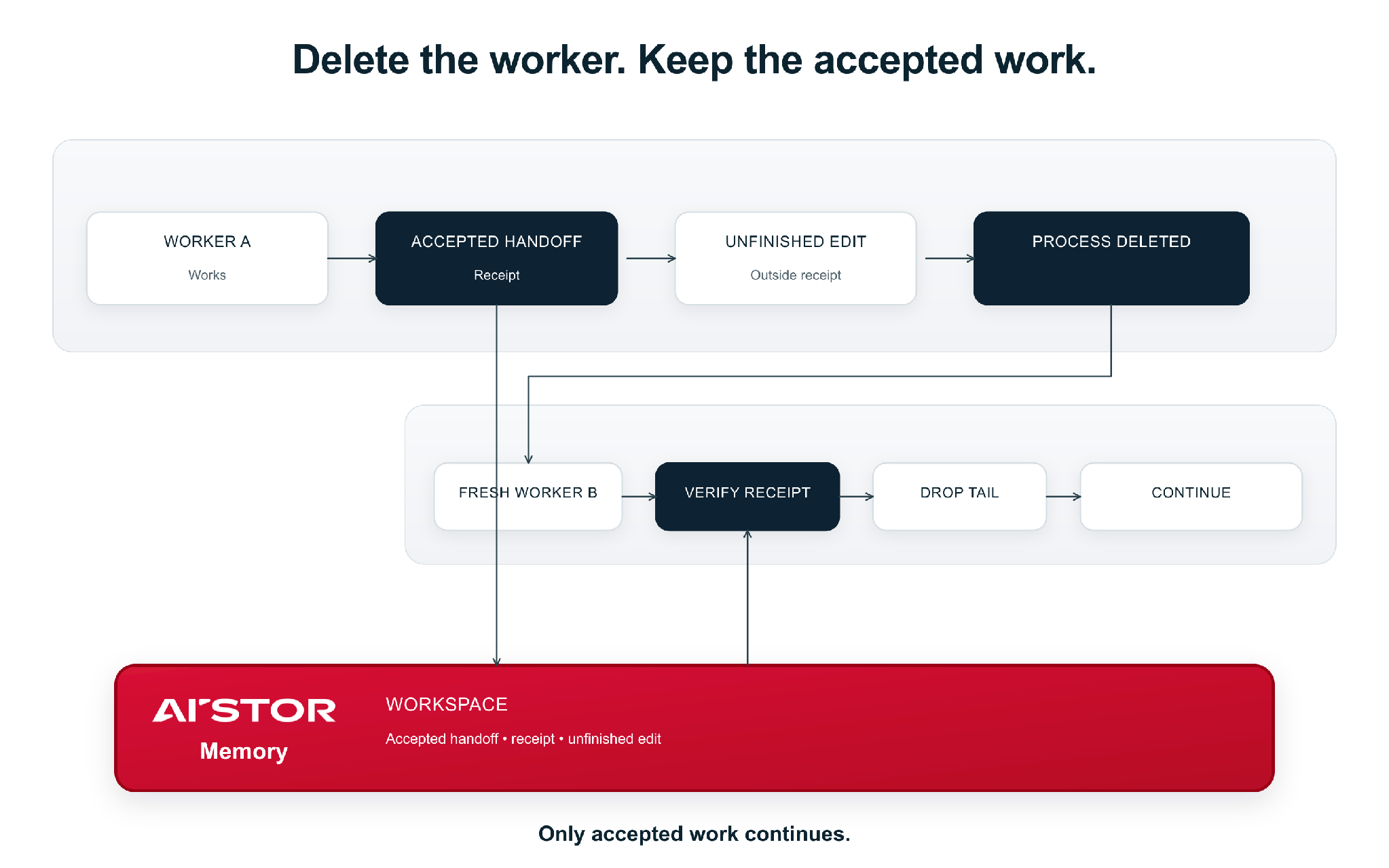
Worker A enters an isolated runtime, gathers evidence, rules out a tempting dead end, and builds a recommendation. It publishes an accepted handoff, begins another edit, and is deleted mid-sentence.
The unfinished tail remains visible. We do not hide the failure behind a clean reset.
Worker B starts in a fresh runtime. It has no prior chat, model session, snapshot, or private process state from Worker A. It receives the same authorized AIStor Memory Workspace, verifies the last accepted boundary, removes the unchecked tail, and continues from the next valid step.
Worker B did not restart the task. It resumed the accepted work.
Workspace turns a session into a handoff
An agent session is temporary by design. The work it produces often should not be.
Plans, evidence, intermediate artifacts, checked outputs, open questions, and accepted handoffs belong to the role, not to one runtime. Without a durable Workspace, every replacement process must reconstruct the job from prompts, summaries, and whatever fragments survived elsewhere.
AIStor Memory keeps that active state under customer control on AIStor. A process can end without turning accepted work into session residue.
This article deliberately isolates the Workspace proof. Long-term Memory carries the role's accumulated experience across many tasks. Vault protects the credentials through which an approved task can act. Workspace answers the immediate question: what accepted work should the next authorized process continue?
Persistence is not enough
Preserving artifacts after a crash is useful. A successor also needs to know which state was accepted and which state was merely present when the process died.
In this demonstration, the customer-controlled wrapper records an external receipt for the accepted handoff. Recovery verifies that receipt before the next inference and removes work written after the boundary. The domain validator, not AIStor Memory, decides what counts as an acceptable result for this task.
AIStor Memory supplies the durable, access-scoped Workspace. The surrounding workflow supplies acceptance policy and recovery verification.
That division is important. It keeps durability reusable while allowing a security investigation, shopping task, research brief, or tournament audit to define its own rules for trustworthy work.
One continuity contract, many runtimes
The runtime decides where an agent executes. AIStor Memory decides what the work can outlive.
The same customer-owned Workspace contract can support local containers, hosted sandboxes, and self-managed infrastructure. Each integration still requires its own qualification, but changing compute does not require redesigning the state the role depends on.
That makes replacement a normal operating event rather than a forced reset:
- a scheduled research role can revisit one living brief;
- a clean investigator can replace a confused predecessor;
- an auditor can inspect the evidence and accepted boundary behind a handoff;
- a compatible model or framework can continue from documented state instead of an opaque session.
Built and verified
The captured qualifications demonstrate scoped AIStor Memory state, observable process termination, an unfinished crash tail, receipt-verified recovery, and isolation from neighboring agent relationships. The wrapper creates and verifies the handoff receipt; AIStor Memory preserves the authorized Workspace beneath that workflow. The technical runbook contains the runtime setup, commands, and evidence receipts.
We deleted Worker A mid-sentence.
Worker B resumed from the last accepted boundary.
.svg)