.svg)


.avif)
Separate agents, separate memories. Each familiar only where it should be, and all of them under your control.
A price alert can report that a product became cheaper, but it cannot tell you whether the discount is meaningful for you. A fitness dashboard can report three missed workouts, but it cannot remember that Tuesday evenings have been overloaded for months, or that a shorter plan worked better the last time life became this busy. An inbox agent can summarize a message, but it cannot know that you promised a reply last week, that this contact prefers a direct tone, or that you already rejected the first draft.
Personal agents become genuinely useful when familiarity accumulates. The inbox agent remembers a promise. The shopping agent learns which "deal" became an expensive return. The fitness agent recognizes the routine that actually worked. The product question is whether that familiarity can deepen without turning one agent into something that quietly accumulates your whole life: every message, purchase, and health record. It never lets go, because the record it hoards has become the product it sells.
AIStor Memory keeps each relationship's learned history, active work, and protected credentials under user control while replaceable workers come and go. You stay in control through a layer you own, the orchestration plane. It decides what each worker may receive, what it may change, and whether it may act.
Three useful agents. Three private relationships.
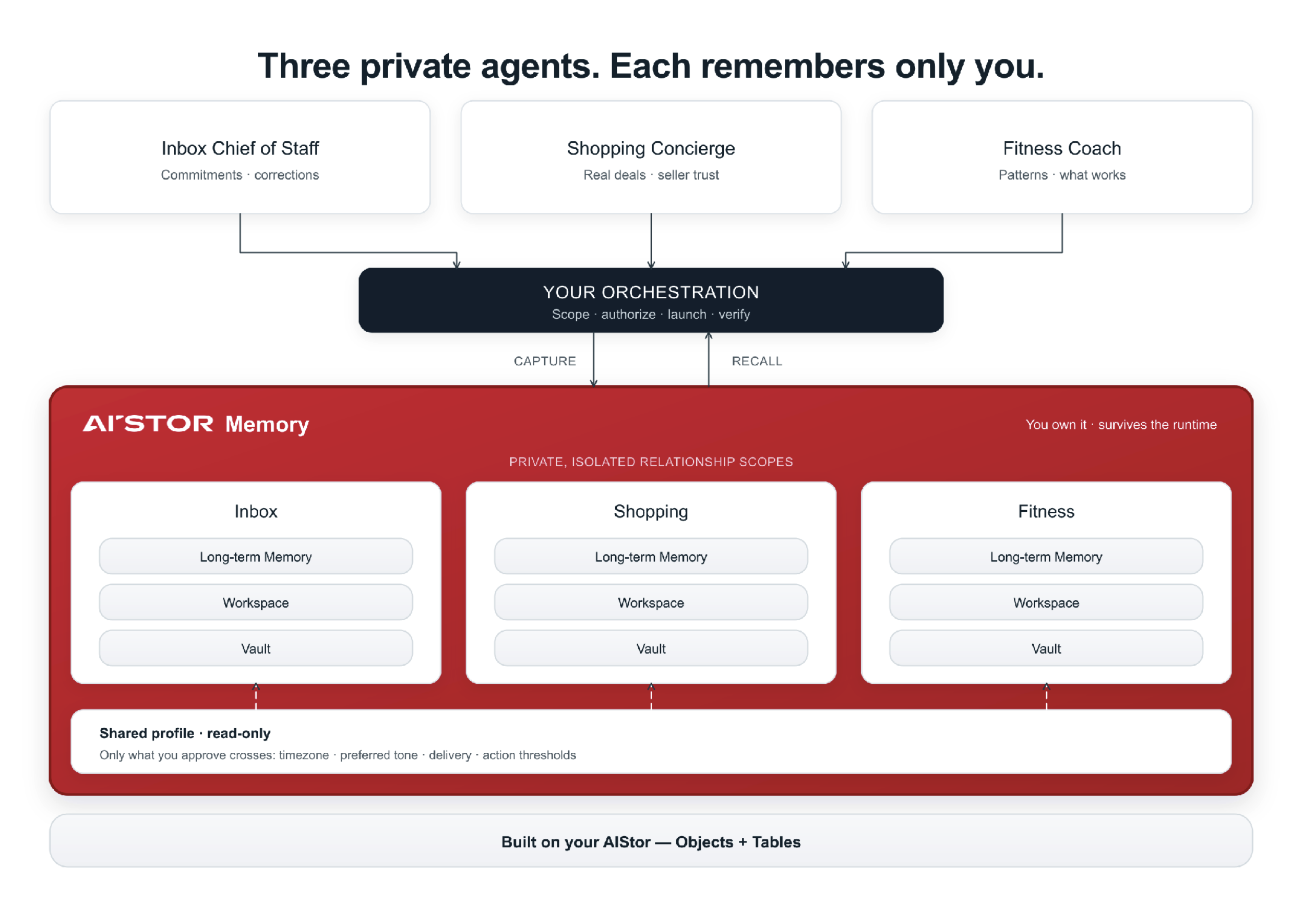
Imagine three agents working for the same person. The Inbox Chief of Staff helps manage commitments and communication. The Shopping Concierge watches for opportunities and prepares purchases for approval. The Fitness Coach looks for patterns across workouts, recovery, schedules, and goals.
They serve one user, but each develops a separate working relationship. The Inbox Chief of Staff does not inherit purchase history. The Shopping Concierge does not receive workout records. The Fitness Coach does not see private correspondence. Their learned history, current work, and credential custody remain separated by relationship.
A small set of facts, such as timezone, delivery constraints, preferred tone, or action thresholds, can be made available across scopes as read-only state when the user explicitly allows it. That is deliberate sharing, not an automatic exchange of everything the agents have learned.
The Inbox, Shopping, and Fitness relationship stories are illustrative. The Apple Container qualification verified the same isolation, read-only sharing of labeled fictional preferences, and checkpoint recovery mechanics with three separately scoped test workers.
The Inbox Chief of Staff remembers commitments, not everything
Each morning, a replaceable Inbox Chief of Staff reviews the current inbox. It does not begin by replaying months of conversations. It receives the commitments, preferences, and accepted corrections relevant to that morning's work, along with the messages in front of it.
That control layer surfaces only that scoped selection, the messages that need attention now. The worker never holds standing access to the whole mailbox, and the biography it records automatically is bounded by that same scope. Familiarity does not require reading everything.
The agent recognizes that a promised reply is still outstanding. It knows the user prefers a concise response with this contact, and that a similar draft was rejected last week for sounding overly formal. That experience shapes a better reply, but it does not become permission to send one.
Long-term Memory preserves the commitment, accepted preference, and correction. Workspace holds the current messages, cited evidence, and proposed replies. If a new worker takes the next shift, it can continue from that accepted state without receiving purchase history, fitness information, or a standing window into the rest of your life.
The value is not merely a better summary. It is an agent that can help close the commitments that still matter while remaining bounded to the work it was asked to do.
The Shopping Concierge distinguishes a deal from a mistake
A conventional price monitor sees that a pair of shoes is advertised at 25 percent off the original price and calls it a deal. The Shopping Concierge checks that claim against the user's own recorded price history and often finds the discount is theater. The "original" was quietly marked up the week before. The same shoes were cheaper last month. The countdown timer resets every time the page reloads. Because the price memory belongs to the user, the store's framing can be measured against what the user actually saw: your own history can't be used against you.
The judgment goes beyond price. This brand ran small, a comparable model fit in a different size, one merchant handled the last return well, and a previous "bargain" became expensive after shipping and restocking fees. When a scheduled monitor finds an offer, the agent combines that history with the current price, availability, delivery date, and return policy. It prepares a comparison and a proposed cart in Workspace, then explains why the offer is better for this person, not merely cheaper than yesterday.
The monitoring task has no payment authority. Only after the user approves the merchant, product, and amount does the user-controlled orchestration plane authorize checkout. Vault keeps the provider-issued credential encrypted in an explicit scope in the user's AIStor. After approval, orchestration retrieves and delivers only that purchase-task scope.
The important moment is not that an AI clicked Buy. It is that the Shopping Concierge applied the user's own experience, caught the manufactured urgency, asked before acting, received narrow authority, and preserved the verified outcome. A later worker can track delivery, remember the return window, and learn whether the recommendation was actually good.
The Fitness Coach learns what works without overreaching
At the end of the week, the Fitness Coach sees that three planned workouts were missed. As a dashboard metric, the week looks like failure. Against the user's history, a different pattern appears: the missed sessions repeatedly fall on the same evenings, shorter workouts on those days were completed more consistently, and progress improved when the plan optimized for weekly consistency instead of daily perfection.
Vault keeps a provider-issued read-only wearable credential encrypted in an explicit scope. With the user's permission, orchestration retrieves that scope for the sync. The Fitness Coach compares the authorized records with the accepted baseline in Long-term Memory and places its cited analysis and proposed adjustment in Workspace.
It does not diagnose a condition or silently rewrite the user's calendar. It explains the observed pattern and asks whether the plan should change. At the next review, another authorized worker can evaluate whether the adjustment helped against the same private history.
That history is intimate. The FTC's health-breach guidance includes measures such as steps, distance, heart rate, weight, height, and age among its examples of identifiable health information. A useful Fitness Coach should not require surrendering a continuing record of the user's life.
Familiarity without ambient access
Convenience often pushes personal AI toward one enormous agent with access to everything. AIStor Memory supports a different arrangement: several bounded relationships, each becoming better at its own job while the user retains control of what may cross a boundary.
The Shopping Concierge does not need workout history. The Fitness Coach does not need purchase receipts. The Inbox Chief of Staff does not need a checkout credential. None needs a standing window into the rest of your life: your messages, your purchases, your health history, or what a neighboring agent has already learned. Familiarity is earned inside one relationship, not by quietly amassing all of them.
Your control layer applies those choices to each task. It selects the permitted Long-term Memory and Workspace, launches an isolated worker, retrieves an approved credential scope when required, and verifies the result before it is accepted. The worker receives the one relationship it was assigned, not a standing key to the user's whole digital life. AIStor Memory keeps the durable knowledge, active work, and protected credentials under the user's control when that isolated process ends.
The relationship outlives the app that runs it
The app or service running your agent will change. You will want to try a newer one, or the one you rely on will be discontinued. Owning the memory means you can switch what runs your agent without losing what it learned about you, and without handing the new one your whole digital life to re-earn that familiarity. The memory lives in your own AIStor, the store AIStor Memory runs on. You can run it on infrastructure you control (your own machine, a home server, or a cloud account you own) and get started with MinIO. The record stays yours, not a vendor's, and the new runtime receives only the scoped relationship it needs.
Personal-agent software is moving quickly, and open frameworks that can run around a memory you own are already emerging. Because the memory is yours, you can carry a relationship to whichever agent you choose. It stays anchored to your memory rather than to the app that happens to hold it this month. Changing the agent assigned to one relationship never requires exposing or rebuilding the others.
Evidence from the qualification
The captured Apple Container qualification exercised separate Inbox, Money, and Security workers against labeled fixtures, not the Inbox Chief of Staff, Shopping Concierge, and Fitness Coach behaviors narrated above, all of which are illustrative. Six cross-scope probes were denied; a shared profile of labeled fictional preferences stayed read-only across every worker; and a clean worker recovered the last accepted checkpoint after its predecessor was destroyed mid-run. Shopping checkout, wearable synchronization, Vault retrieval, and orchestration-authorized actions using Vault-held credentials are product scenarios in this article, not steps attributed to that run. The qualification record preserves the exact evidence and reproduction details.
Personal AI should improve along two dimensions at once: familiarity and restraint. The Inbox Chief of Staff should remember commitments. The Shopping Concierge should learn from returns and outcomes. The Fitness Coach should recognize patterns that a weekly score cannot explain. None should need everything another agent knows, or receive authority the user did not approve. The memory that makes them familiar should remain the user's own.
Know me deeply. Share narrowly. Act only with my approval.
.svg)